New Zealand Bus Safety: Regulations, Accidents, and Enforcement
New Zealand has robust systems to ensure bus safety. These systems cover drivers, vehicles, and bus operators. The goal is to make public transport as safe as possible for everyone.
Driver Requirements and Standards
Licensing and Endorsements
All bus drivers in New Zealand need a specific driver’s licence. This is usually a Class 2 or higher for heavier buses. More importantly, they must get a Passenger (P) Endorsement on their licence.
Becoming a “Fit and Proper” Driver
To get this P endorsement, drivers go through a thorough process. First, they face background checks, including police checks. This is to ensure they are considered “fit and proper” to transport passengers. Furthermore, they must pass medical fitness exams.
Road Rules and Professional Conduct
Once licensed, drivers must always follow all road rules. This means respecting speed limits and driving sober and alert. They must also follow the New Zealand Road Code at all times.
Managing Driver Fatigue
Crucially, there are strict rules about work-time and rest breaks. These rules limit how long drivers can drive without a break. For example, there’s a maximum continuous driving period. After a set number of hours, mandatory rest is required. This helps manage driver fatigue effectively.
Accountability and Penalties
Drivers must keep detailed logbooks of their hours. Exceeding work-time limits or other rule breaches can lead to penalties. In some cases, their licence might even be suspended.
Vehicle Safety Requirements
Certificate of Fitness (CoF)
Buses themselves face strict safety requirements. Every bus needs a current Certificate of Fitness (CoF). This means certified inspectors check the vehicle every six months. The CoF ensures the bus is roadworthy.
Key Inspection Areas
These inspections cover all critical safety parts. For instance, they check brakes, tires, lights, steering, and the bus’s main structure.
Specific Safety Standards
Moreover, buses must meet standards in the Land Transport Rule: Passenger Service Vehicles 1999. This rule sets specific requirements. These include standards for emergency exits, doors, and aisles. It also covers seating strength, spacing, and safety equipment. Fire extinguishers and first-aid kits are examples of required equipment.
Seatbelt Use
Many modern buses have seat belts. If seat belts are fitted, passengers are legally required to wear them.
Higher Standards for Contracted Services
Operators with government contracts, like school bus services, often have even stricter rules. For instance, the Ministry of Education requires school buses to be below a certain age. They also need GPS or telematics systems. Plus, drivers for these services often undergo additional training and annual medical checks.
Operator Licensing and Responsibilities
Passenger Service Licence
Bus operators (the companies or individuals running services) must hold a special Transport Service Licence. This licence is specifically for passenger services. It confirms the operator has met all legal duties to run such a business.
Maintaining “Good Standing”
To get and keep this licence, operators must remain in “good standing.” This includes meeting the “fit and proper person” criteria. They must also consistently maintain safety compliance.
Operator Duties
Operators are responsible for several things. They must ensure all their drivers are properly licensed and endorsed. Additionally, every vehicle in service must be certified and well-maintained. Operators also need to display their transport service licence number on their vehicles. Finally, they must have proper liability insurance.
Comprehensive Regulatory Framework
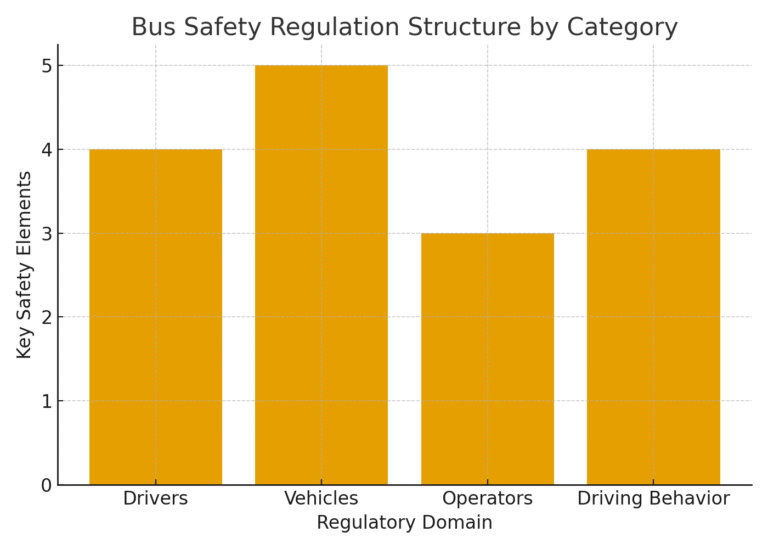
In summary, the regulatory framework covers three main areas: drivers, vehicles, and operators. Each area must meet specific safety standards. Only then can they legally provide bus services to the public.
Historical Major Bus Accidents Since 1950
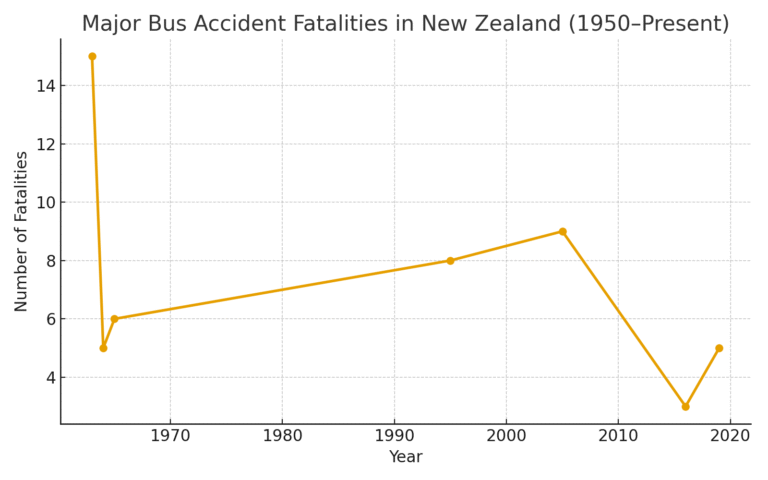
Despite strong safety measures, New Zealand has seen some serious bus accidents. Here are key incidents since 1950, detailing their year, location, causes, and outcomes.
1963 – Brynderwyn Hills, Northland: Brake Failure Tragedy
On 7 February 1963, a fully loaded bus lost control. This happened while it was going down the Brynderwyn Hills. Tragically, the bus’s brakes failed on a steep slope, causing it to go off the road.
Impact and Aftermath
Cause: Brake failure, a mechanical malfunction, led to a loss of control. Outcome: 15 people died, and many were injured. This remains New Zealand’s worst bus road accident. The disaster led to a greater focus on vehicle maintenance and brake testing for heavy passenger vehicles.
2016 – Gisborne Region, North Island: Christmas Eve Crash
On Christmas Eve 2016, a bus crashed south of Gisborne. It was carrying a school brass band. The bus went off the road and fell 100 metres down a steep bank into a riverbed.
Investigation and Consequences
Cause: Investigations suggested a sudden brake failure. The bus was on a winding road. Wet conditions might also have played a role. Outcome: Three people died, and about 40 were injured. This sad event prompted a major safety review. The operator faced close examination of their maintenance. Court cases followed, leading to new efforts to inspect all buses, especially older ones.
2019 – State Highway 5 near Rotorua: Tour Bus Rollover
On 4 September 2019, a tour coach carrying Chinese tourists overturned. This happened on a highway north of Rotorua.
Causes and Global Attention
Cause: The crash occurred in very bad weather, with heavy rain and a slick road. The bus lost control on a wet section of the highway. Driver error, combined with difficult weather, likely caused the rollover. Outcome: Five Chinese tourists died, and over 20 were injured. This accident made international news.
Lessons Learned
It led to reviews of driver training, especially for wet weather driving. Emergency response procedures were also checked. The investigation found no mechanical faults with the bus. This reinforced the need for drivers to be vigilant and cautious in bad weather.
Other Notable Incidents
In 2019, another serious bus crash happened near Tīrau. It involved a small tour bus, resulting in one death and 14 injuries. This showed that even minor errors can have big consequences with buses. However, fatal bus crashes are rare in New Zealand. Each major incident has led to better safety oversight.
Violation and Penalty Mechanisms
New Zealand law sets penalties for both drivers and operators who violate safety rules. The specific penalties depend on who is responsible.
Penalties for Bus Drivers
Minor Violations
Drivers caught speeding, running red lights, or driving dangerously face immediate fines. They also get demerit points on their licence. If a driver collects too many demerit points, their licence can be suspended for a period.
Serious Offences
For serious wrongdoing, like causing an accident through reckless driving, a driver can be charged in court. Penalties can include large fines, losing their licence for a long time, or even prison. This is especially true if their actions cause deaths or injuries.
P Endorsement Review
Since bus drivers have a special P endorsement, any major violation or criminal offence can trigger a review. The NZ Transport Agency checks if they are still “fit and proper.” If a driver is no longer deemed safe, the Agency can revoke their P endorsement. This stops them from working as a commercial bus driver.
Driver Accountability
In short, drivers are personally held responsible for following road safety laws. Penalties like licence suspension, endorsement cancellation, fines, and criminal charges encourage safe and responsible driving at all times.
Penalties for Bus Operators
Enforcement Actions
Operators who fail to maintain safety standards can face action from Waka Kotahi (NZ Transport Agency) and other bodies. For example, if a bus runs without a current CoF, or with known mechanical flaws, the operator can be ordered to take it off the road.
Licence Suspension or Revocation
The NZ Transport Agency can suspend or revoke an operator’s Transport Service Licence. This happens if serious safety breaches are found. Essentially, it shuts down the business’s ability to operate passenger services legally. Operating without a proper licence can result in large fines.
Health and Safety at Work Act
New Zealand’s Health and Safety at Work Act 2015 also applies to bus companies. Operators must ensure the safety of their workers (drivers, maintenance staff) and passengers. If negligence leads to an accident – like not servicing brakes or overworking drivers – WorkSafe New Zealand can prosecute the company.
Severe Fines and Reparations
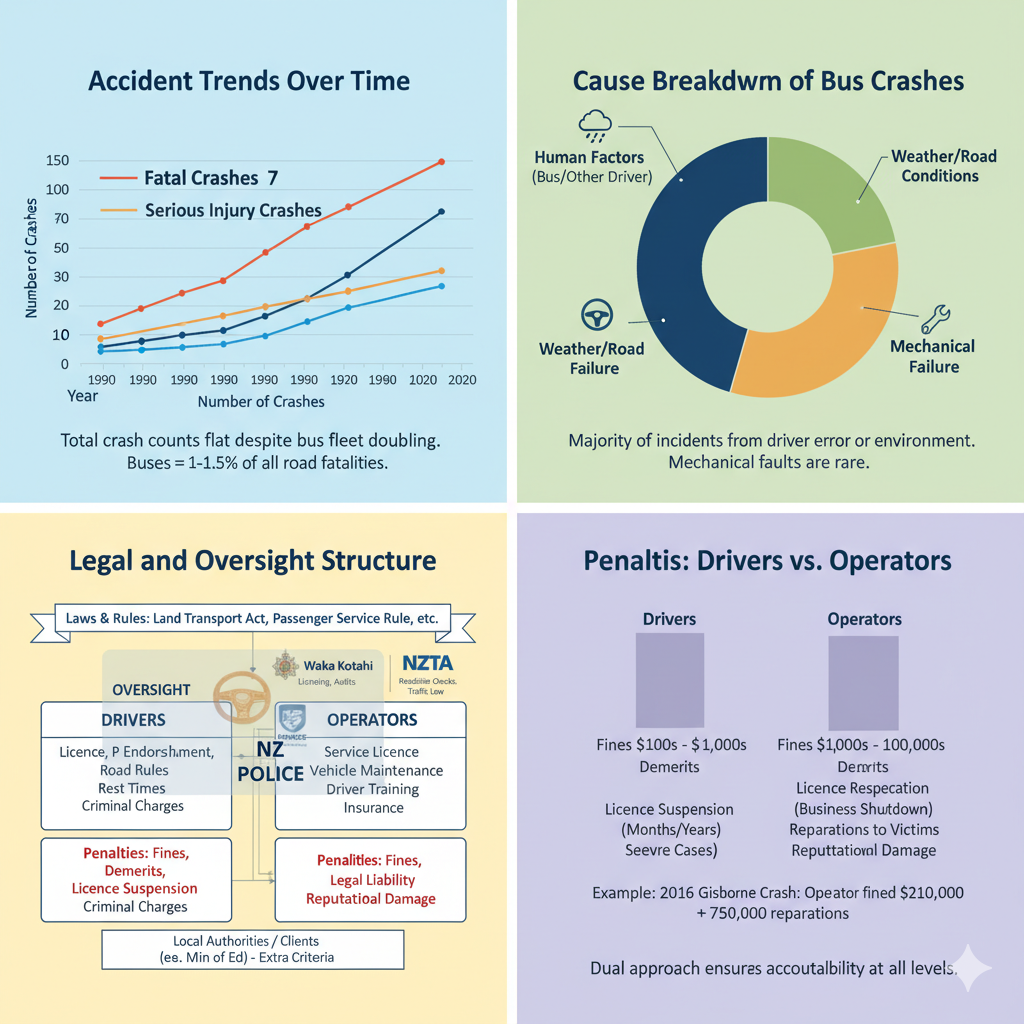
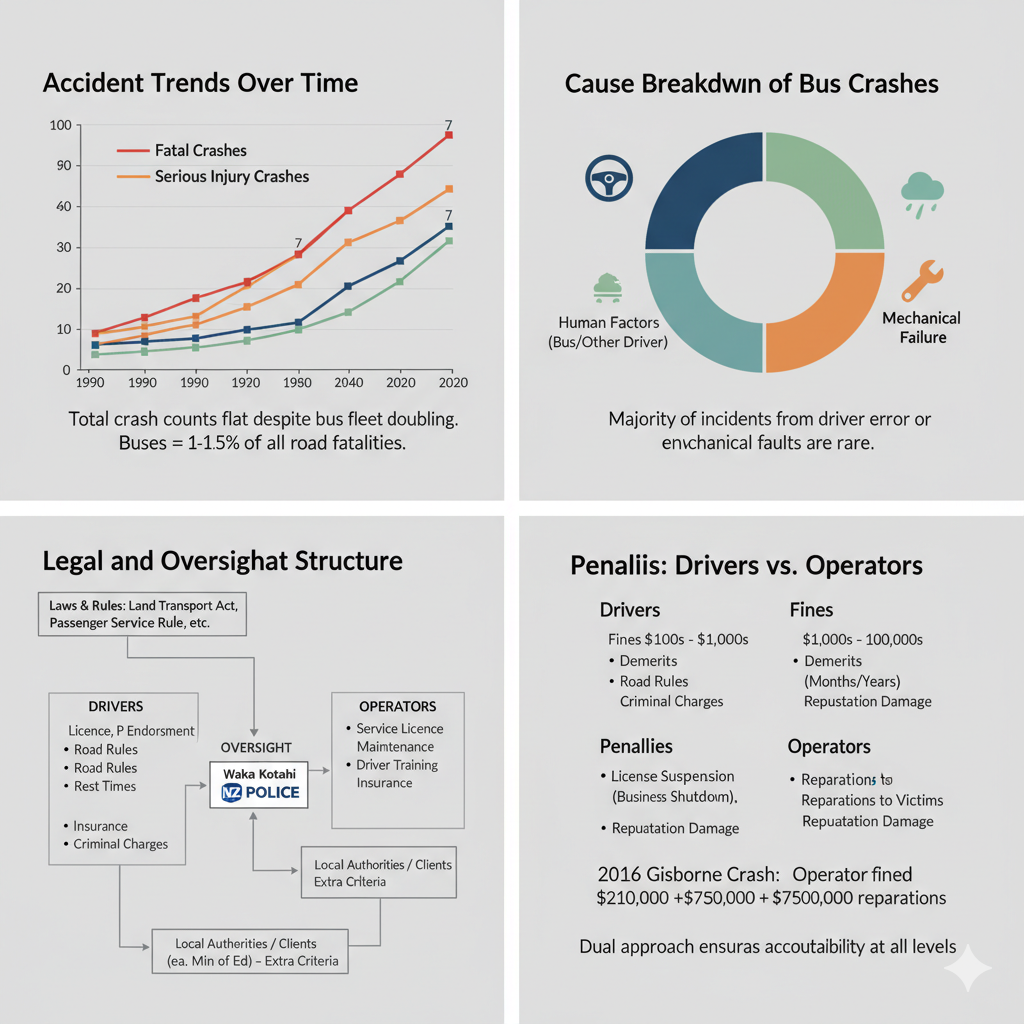
Such prosecutions carry very heavy penalties. After the 2016 Gisborne bus crash, for instance, the bus company was fined NZ$210,000 under health and safety law. They also had to pay $750,000 in reparations to victims’ families. Company directors or managers can even face personal charges for gross negligence.
Operator Accountability
In conclusion, operators face strict oversight. They can be fined heavily, lose their operating licence, and suffer severe reputational damage. These penalties ensure both the individual driver and the managing organization prioritize safety.
Sources of Safety Data and Studies
New Zealand’s bus safety regulations are based on official data and studies. These sources help inform and improve safety outcomes.
Waka Kotahi NZ Transport Agency (NZTA)
The NZTA publishes rules, guides, and statistics on road safety. Their website provides detailed information on all bus regulations. This includes licensing, vehicle standards, and driver duties. For example, the Official New Zealand Road Code is found there.
Crash Analysis System
The agency also runs the Crash Analysis System. This database holds records of all road crashes in New Zealand. Researchers and policymakers use it to study bus accident trends and find risk factors. NZTA’s data shows how many crashes involve buses each year and their causes. Their publications are a main source for safety statistics.
Ministry of Transport
The Ministry of Transport researches and reports on transport safety, including bus safety. They produce reports like “Bus Safety in New Zealand.” These reports give a full overview of bus safety. For example, a 2019 Ministry analysis showed that bus travel was the safest road travel per kilometer between 2010 and 2014.
Annual Statistics
The Ministry’s annual Road Safety Statistical Analysis also breaks down crashes by vehicle type. These official stats show that buses cause only a small fraction of road deaths each year. These studies are good for seeing trends and checking how well current rules work.
Legislation and Rule Publications
The actual laws and rules are on government websites. The Land Transport Act 1998 is the legal base for traffic rules. Specific Land Transport Rules (like Operator Licensing Rule 2017) are also published. These sources detail the exact legal requirements. Companies use these when making their safety policies.
Official Statistics and Research
Besides government agencies, independent groups and research bodies also analyze transport safety. The New Zealand Road Safety Annual Report provides updated accident figures. Universities or research groups sometimes study public transport safety. Their findings can offer insights into specific problems, like driver fatigue. Local councils, which contract bus services, also release reports on their public transport safety.
Evidence-Based Safety
All these sources give a full picture of bus safety. Official data confirms bus travel is very safe compared to other transport. Studies and statistics help guide ongoing improvements. For example, if data shows a certain type of accident is more common, regulators can act fast. This combination of data and research ensures bus safety policies are based on facts and updated as needed.
Conclusion
In conclusion, New Zealand has a thorough approach to bus driving safety. It combines strict upfront standards for drivers, vehicles, and operators. This is paired with ongoing enforcement and accountability. The historical data shows relatively few major bus accidents. Importantly, each incident has led to new lessons and safety improvements. By constantly analyzing safety data and enforcing regulations, New Zealand aims to keep bus transport one of the safest ways to travel.