
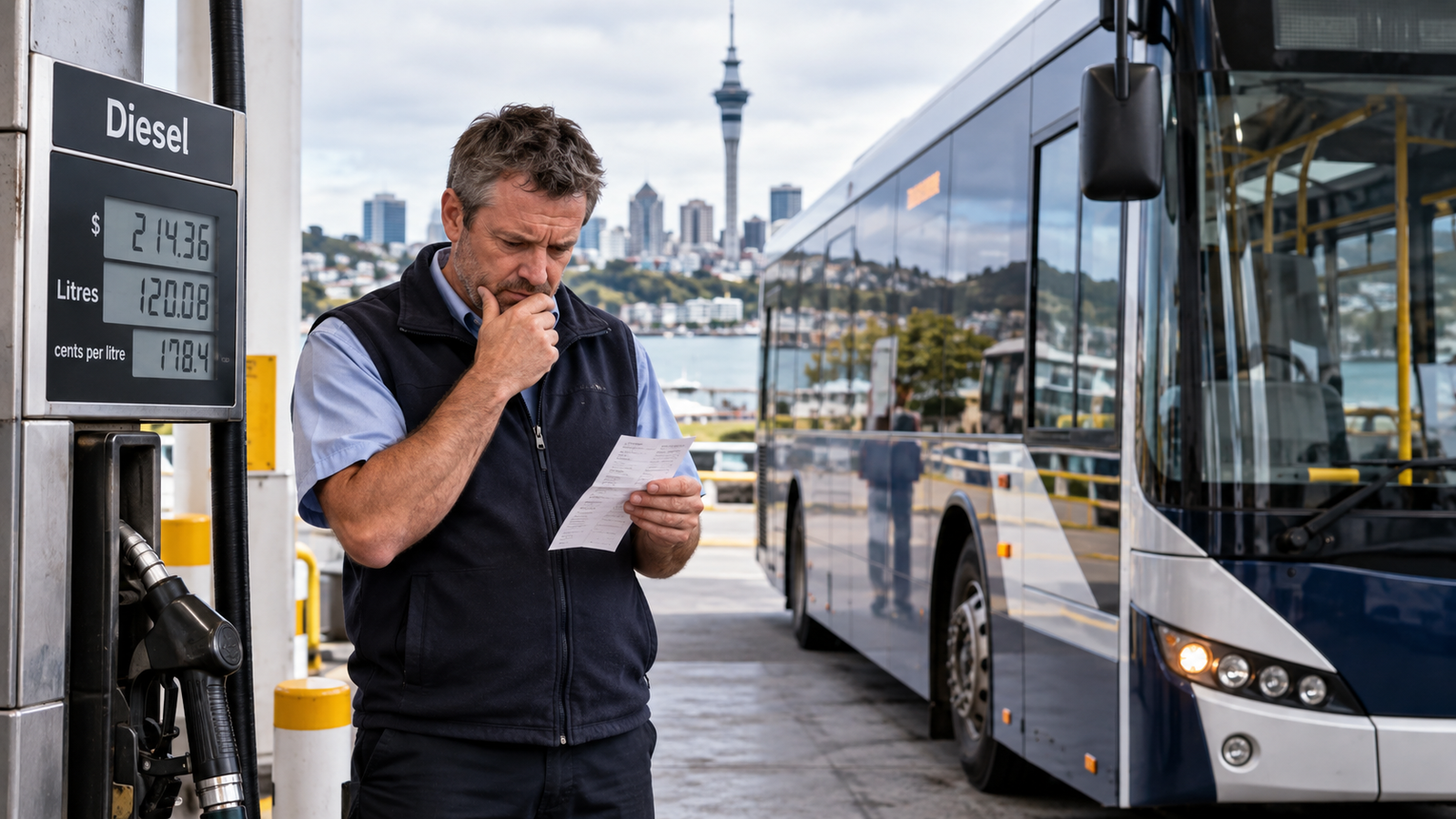
What High Diesel Prices Mean for New Zealand’s Bus Industry
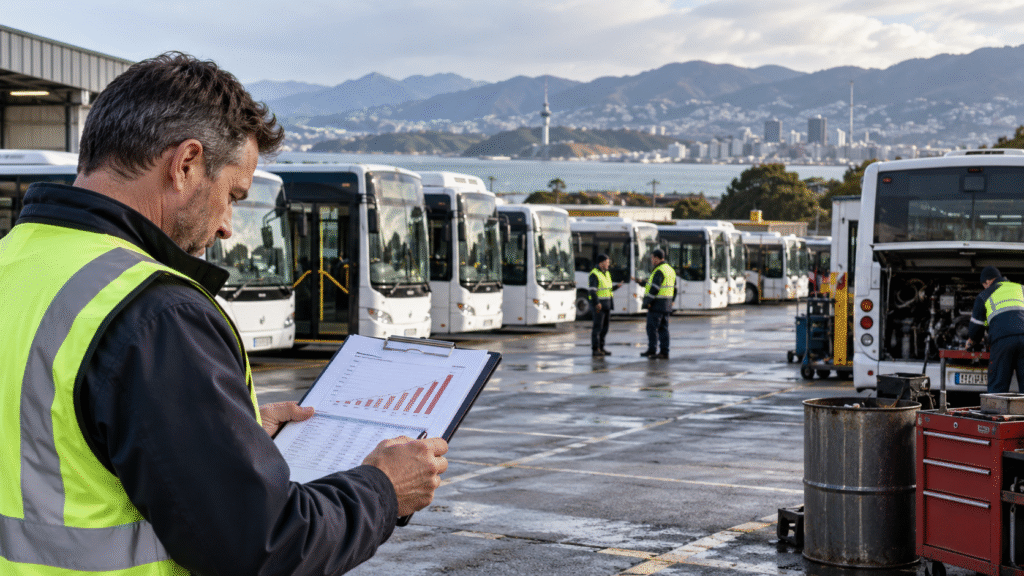
Diesel remains a major operating cost for many bus and coach services across New Zealand. When fuel prices rise sharply, the impact spreads well beyond the fuel tank. It affects operators, transport authorities, contract payments and, indirectly, drivers and passengers.
For urban public transport, the effect is partly cushioned by New Zealand’s contract indexation system. But that does not mean operators are completely protected from sudden fuel-price shocks.
1. Higher diesel prices increase operating costs immediately
A bus travelling hundreds of kilometres each day consumes a significant amount of fuel. When diesel prices rise, operators face higher costs from the first day they refuel.
For a large fleet, even a relatively small increase in the price per litre can turn into a substantial monthly expense.
Fuel is not the only cost of running a bus operation — wages, maintenance, tyres, insurance, road user charges and depot costs also matter — but diesel remains one of the most volatile inputs for conventional fleets.
NZTA’s public transport contract guidance specifically treats fuel as an operational cost that must be included in contract indexation arrangements. 新西兰交通局
2. Contracted urban bus operators have some protection
Many New Zealand urban bus services operate under long-term contracts with public transport authorities.
For contracts co-funded through the National Land Transport Fund and lasting more than 12 months, NZTA requires an approved indexation mechanism. This allows contract payments to move as major input costs such as fuel and labour change. 新西兰交通局
In simple terms:
If diesel costs rise, part of that increase can eventually be reflected in higher contract payments.
This is important because operators tender for contracts that may last several years. Without indexation, they would have to predict future fuel prices years in advance or carry much greater financial risk.
3. The problem is timing
Indexation does not always mean the operator receives extra money immediately.
NZTA itself identified this problem in 2026 when sharp diesel-price volatility created a gap between the time operators paid higher fuel bills and the time contract indexation caught up.
NZTA introduced temporary monthly interim diesel adjustments for bus and ferry contracts because the normal data and quarterly adjustment process could create cash-flow pressure for operators during periods of rapidly rising fuel prices. 新西兰交通局
This distinction matters.
An operator may eventually recover much of the indexed fuel-cost increase, but it may still have to fund the higher diesel bill first.
For a company operating hundreds of buses, that timing difference can be significant.
4. Not every bus service is equally protected
Urban contracted services are only part of the industry.
School transport, charter work, tourism coaches, private contracts and other commercial services may operate under very different agreements.
Where contracts do not provide adequate fuel-cost adjustment, the operator may have to:
- absorb part of the increased cost,
- renegotiate contracts,
- increase charter or commercial prices,
- reduce margins,
- or reconsider whether marginal services remain financially sustainable.
This means a diesel-price shock can affect different operators very differently.
5. Passengers may not see an immediate fare increase
Higher diesel prices do not automatically mean bus fares rise the next day.
For contracted public transport, fares, subsidies and operator payments are part of a broader funding and contracting system. In Auckland, for example, bus and ferry services are delivered through contracted public transport arrangements rather than each operator independently setting prices based simply on its current fuel bill. 奥克兰交通
However, sustained higher operating costs eventually have to be paid by someone.
That burden can ultimately fall across a combination of:
transport authorities + central government funding + ratepayers + passengers + operators.
So even where the individual passenger does not immediately notice the fuel-price increase, the transport system still carries the cost.
6. High diesel prices can affect future service decisions
When the cost of operating diesel buses rises for a sustained period, authorities and operators face tougher choices.
Higher operating costs can influence:
- future contract prices,
- budgets for additional services,
- frequency improvements,
- route expansion,
- fleet replacement decisions,
- and the overall subsidy required to maintain existing services.
This does not necessarily mean routes will be cut whenever diesel becomes expensive. But it reduces the amount of financial room available elsewhere in the system.
That can matter particularly when transport budgets are already under pressure.

7. What does it mean for bus drivers?
Drivers do not normally buy the diesel themselves, but they can still feel the consequences of higher fuel costs.
Financial pressure on an operator can influence decisions about:
- overtime,
- spare vehicles,
- depot operations,
- scheduling,
- recruitment,
- maintenance planning,
- and how aggressively companies compete for future contracts.
Fuel prices should never justify compromising vehicle safety or legally required working conditions. But from an operational perspective, higher costs can increase pressure across the entire business.
One important distinction is that NZTA’s current indexation framework separately recognises driver labour costs. For relevant bus contracts, the labour component of contract price adjustments must be passed through to the bus-driver workforce in the form of wage increases, at least annually. 新西兰交通局
So fuel indexation and driver wage indexation are not the same thing.
8. Expensive diesel strengthens the case for electric buses — but the calculation is more complicated
High diesel prices naturally make battery-electric buses more attractive from an energy-cost perspective.
NZTA now maintains separate indexation arrangements for diesel buses and battery-electric buses, and even provides a method for contracts operating mixed fleets. 新西兰交通局
Electric buses are not “free to operate”. They still require:
- electricity,
- charging infrastructure,
- depot upgrades,
- batteries,
- maintenance,
- and significant upfront capital investment.
But electric fleets reduce direct exposure to diesel-price volatility.
For operators and transport authorities planning fleets over 10 or 20 years, that difference becomes increasingly important.
The bigger picture
A diesel-price increase is easy to describe as a fuel problem.
For the bus industry, it is really a contract, cash-flow and transport-funding problem as well.
New Zealand’s indexation system protects contracted operators from carrying all of that risk themselves, but rapid price movements can still create short-term pressure. Commercial operators may have much less protection.
And over the longer term, every period of expensive and volatile diesel strengthens the economic argument for reducing dependence on fossil-fuel buses.
For drivers, the important point is simple:
The price at the pump may be paid by the company, but its effects can travel through the entire bus industry.