A recent Glenfield incident shows why interfering with a moving bus is a serious public-safety threat.
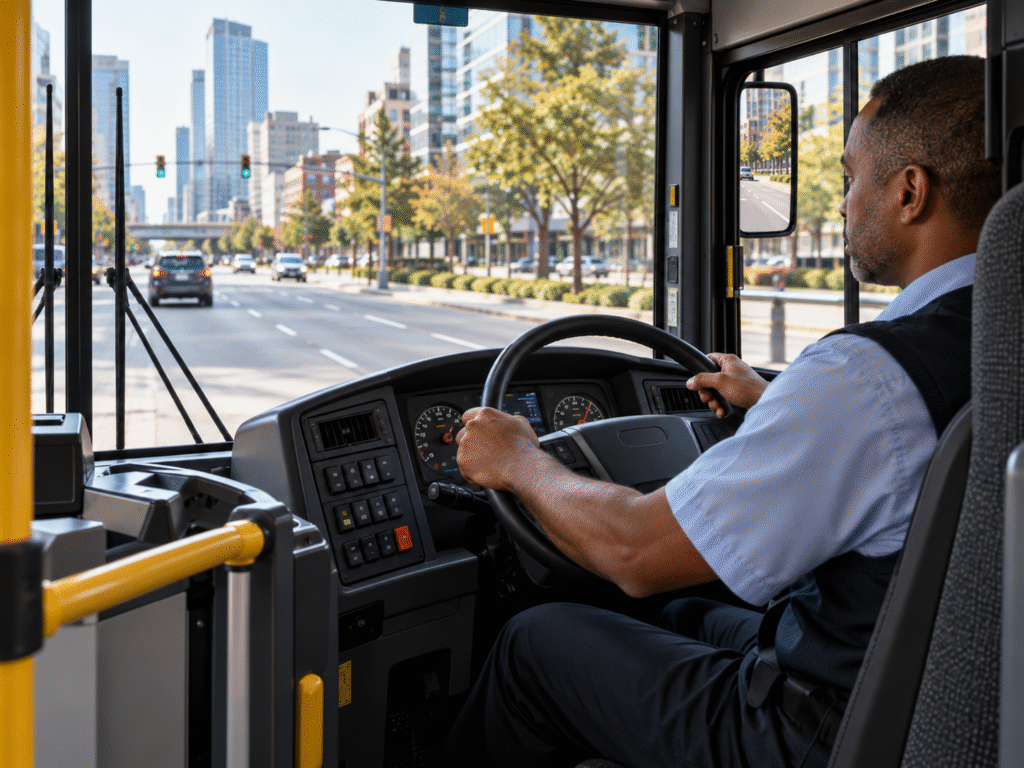
This article is based on a recent incident in the Glenfield area, where a passenger who wanted to get off closer to their destination attempted to interfere with a bus driver’s steering wheel.
The driver responded calmly and decisively, loudly warned the passenger to stop the dangerous behaviour, and successfully prevented the interference from escalating. In doing so, the driver helped maintain control of the vehicle and protect the safety of the passengers on board.
Interfering with the control of a moving bus is extremely dangerous and should never be treated as trivial behaviour.
A passenger reaching toward a bus steering wheel is not a joke, not a shortcut, and not a harmless moment of frustration. It is one of the most dangerous things that can happen inside a moving passenger vehicle.
A bus driver is not only responsible for one person. A driver may be carrying multiple passengers, moving through traffic, approaching intersections, travelling on narrow roads, or operating in conditions where even a brief interference with steering can place many lives at risk.
Why it is so dangerous
A moving bus is a large, heavy passenger vehicle. It does not stop, turn or recover like a small private car.
Even a brief grab, pull, push or obstruction at the steering wheel can create a serious hazard.
The risk is not limited to the driver. It may extend to:
- passengers seated or standing inside the bus,
- people boarding or getting off,
- pedestrians,
- cyclists and motorcyclists,
- drivers in nearby traffic,
- and anyone in the path of a vehicle that suddenly deviates from its course.
What may feel like “just one second” to an angry passenger can become a life-changing event for many other people.
This is not ordinary bad behaviour
There is a difference between a difficult passenger and a passenger who physically interferes with the driver’s control of the vehicle.
Complaints, fare disputes, missed stops or arguments are one thing.
Reaching for the steering wheel is another.
At that point, the issue is no longer simply customer service or a disagreement about where someone wants to get off.
It becomes an immediate safety threat.
The law can treat serious violence very seriously
It is important not to oversimplify criminal law.
Not every attempt to interfere with a steering wheel automatically results in one specific charge or one specific sentence. The legal outcome depends on the facts, the intent, the level of force, the risk created, any injury caused and the evidence available.
However, New Zealand law clearly treats serious violence and serious injury as grave matters.
For example, under section 188 of the Crimes Act 1961, wounding or causing grievous bodily harm with intent can carry a maximum sentence of 14 years’ imprisonment. That does not mean every steering-wheel incident automatically carries a 14-year penalty. It means serious conduct causing serious harm can attract very serious consequences. 新西兰立法
The point is simple:
Nobody should treat interference with the control of a moving bus as harmless behaviour.
Stop immediately, or move to a safer place?
This is one of the hardest practical questions.
People often say:
“Just stop the bus immediately.”
In some situations, that may be exactly the right response.
But real road conditions are not always simple.
A bus may be:
- on a motorway,
- on a blind bend,
- in fast-moving traffic,
- near an intersection,
- beside a narrow shoulder,
- or in a location where an abrupt stop may create a second danger.
New Zealand’s Road User Rule places specific limits on stopping on motorways and allows use of an emergency stopping lane in an emergency or to avoid a collision. 新西兰立法
So the safest principle is not simply:
“Stop immediately no matter where you are.”
Nor should it be:
“Keep driving until you reach a convenient bus stop.”
The better principle is:
Maintain control, reduce the immediate danger, and stop as soon as it is safe and practicable in the actual circumstances.
That may mean stopping immediately.
It may mean moving only a short distance to a safer position.
What matters is not convenience. What matters is preventing a worse outcome.
Can a driver use physical force to stop the interference?
This needs careful wording.
A driver is not there to punish passengers.
A driver is not there to “teach someone a lesson”.
But a driver is also not required to simply surrender control of the vehicle while a dangerous act is happening.
Section 48 of the Crimes Act 1961 recognises self-defence and defence of another. It allows a person to use such force as, in the circumstances as that person believes them to be, it is reasonable to use in defence of themselves or another person.
That matters in a bus environment because the driver may not only be protecting themselves.
The driver may also be protecting passengers and other road users.
If a person is actively reaching for or grabbing the steering wheel, immediate physical action may be necessary to stop that movement.
That may involve blocking, pushing away, controlling an arm, or otherwise interrupting the action that is creating the danger.
The legal and practical issue is not whether the driver used force.
The real issue is:
Was the force reasonably directed at stopping an immediate danger?
Stopping danger is not the same as punishing someone
This distinction is critical.
If a passenger is reaching toward the steering wheel, stopping that hand may be necessary.
If a passenger is physically interfering with vehicle control, preventing that interference may be necessary.
But once the danger ends, the justification changes.
A driver who continues using force after the threat has ended may move into a very different legal situation.
So the principle should be:
Use only the force reasonably necessary to stop the immediate danger — not to retaliate, punish, or take revenge.
The purpose is safety.
Not punishment.
Why there cannot be one fixed physical response
Every incident is different.
A passenger reaching toward the wheel at low speed is not the same as a passenger grabbing the wheel on a fast road.
An empty bus is not the same as a fully loaded bus.
A momentary attempt is not the same as repeated interference.
A driver who has another safe option available may be in a different position from a driver who has no realistic alternative in the seconds available.
That is why no responsible safety website should say:
“If a passenger touches the steering wheel, always do exactly this.”
The proper principle is broader:
Use the minimum reasonable force necessary to stop the immediate danger and regain safe control of the situation.
Public safety comes before convenience
No passenger’s convenience is worth the risk created by interfering with a moving bus.
Not because of a missed stop.
Not because of a fare dispute.
Not because someone wants to get off immediately.
Not because someone is angry.
A bus driver is carrying other people’s lives, not just a timetable.
If you want to drive, become a driver
There is also a straightforward point here.
If someone genuinely wants the responsibility and experience of driving a bus, there is a proper way to do it:
- get the correct licence,
- meet the passenger-service requirements,
- complete the required training,
- learn the rules,
- and accept the responsibility that comes with carrying the public.
Trying to “share the driving” by reaching toward another person’s steering wheel from the passenger area is not bold, clever or justified.
It is dangerous.
If you want to enjoy driving a bus, do it lawfully:
Train for the job. Qualify for the job. Sit in the correct seat.
A practical response for drivers
No one-line procedure can fit every situation, but a few principles are clear.
1. Keep control of the vehicle
Steering, braking and road awareness come first.
2. Stop the interference
Do not allow dangerous contact with vehicle controls to continue.
3. Stop as soon as it is safe and practicable
Do not create a second, greater road hazard if it can reasonably be avoided.
4. Get help
If there is an immediate threat, call 111 when safe to do so and contact Control or the relevant operator support process.
5. Preserve the facts
CCTV, time, location, witness details and a clear written account may all be important after the event.
Evidence is not about revenge.
It is about making sure the facts are available.
A bus has one driver
A bus contains many controls.
Doors.
Radio.
Ticketing equipment.
Emergency systems.
But the steering wheel and braking controls are different.
They determine where the vehicle goes.
Passengers may complain.
They may question a decision.
They may make a formal complaint later.
But while the bus is moving, vehicle control cannot become part of the argument.
The principle is simple:
THE DRIVER’S SEAT HAS ONE DRIVER.
A moving bus does not need two people fighting for control.
Final point
A steering wheel is not a prop.
It is not a pressure point in an argument.
It is not something a passenger gets to touch because they are unhappy about where the bus is stopping.
The Glenfield incident is a reminder that a passenger’s attempt to interfere with the steering of a moving bus can place the driver, passengers and other road users at immediate risk.
The driver’s task in those seconds is difficult:
Keep control. Stop the danger. Avoid creating a second danger. Protect the people on board.
That is why bus-driver safety needs more than slogans.
Drivers need clear procedures, realistic training, strong incident reporting, reliable CCTV preservation and confidence about the legal boundaries around reasonable defensive action.
And for passengers, the message is even simpler:
Do not touch the steering wheel. Ever.
Disclaimer:
This article provides general safety and legal information only and is not legal advice. It does not identify any operator, route, vehicle or individual. The legal outcome of any incident depends on its specific facts and the applicable law.