
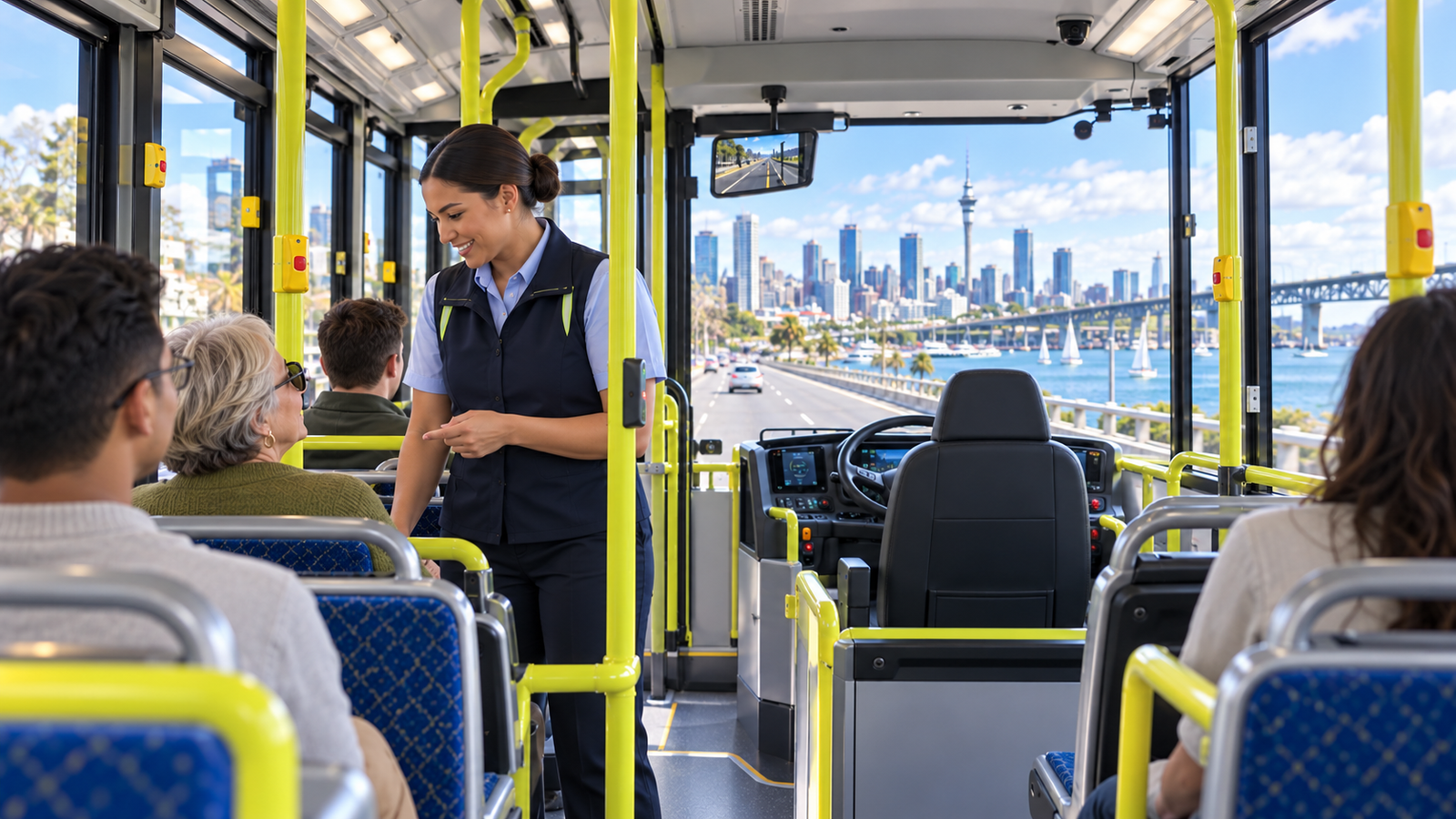
Auckland’s bus fleet is changing quickly.
Electric buses are no longer a small trial or a distant idea. Auckland Transport says more than 400 electric buses are already operating across the city, and its long-term goal is for the entire bus fleet to be electric by 2035. Auckland Transport
In March 2026, AT also announced a major new bus contract that will add another 125 electric buses by July 2027. That programme is expected to bring Auckland’s low-emission bus fleet to nearly 600 vehicles, around 44 percent of the total fleet. Auckland Transport
Electrification is already changing the bus.
But the next technological shift could change something even bigger:
the job of the bus driver.
The question is no longer simply whether buses will become automated.
The more important question is:
If buses can eventually drive themselves, what happens to the person who currently sits behind the wheel?
The answer may not be as simple as “the driver disappears”.
A more realistic future could be one in which bus drivers spend less time driving — but take on a much larger role in safety, passenger care, supervision and intervention.
Electrification changes the bus. Automation changes the job.
Electric buses and autonomous buses are often discussed as if they were part of the same technological change.
They are not.
Electrification mainly changes the vehicle’s propulsion system.
The driver still:
- controls the vehicle,
- watches the road,
- deals with passengers,
- responds to incidents,
- communicates with Control,
- manages unexpected situations,
- and remains responsible for the journey.
Automation is different.
If automated driving systems eventually take over more of the driving task, they begin to change the division of responsibility between the vehicle and the human.
The question becomes:
- Who controls the bus?
- Who watches the system?
- Who helps passengers?
- Who handles unusual situations?
- Who takes over when automation reaches its limits?
That is why automation could have a much greater effect on the profession than electrification alone.
Fully driverless buses may not begin on ordinary suburban streets
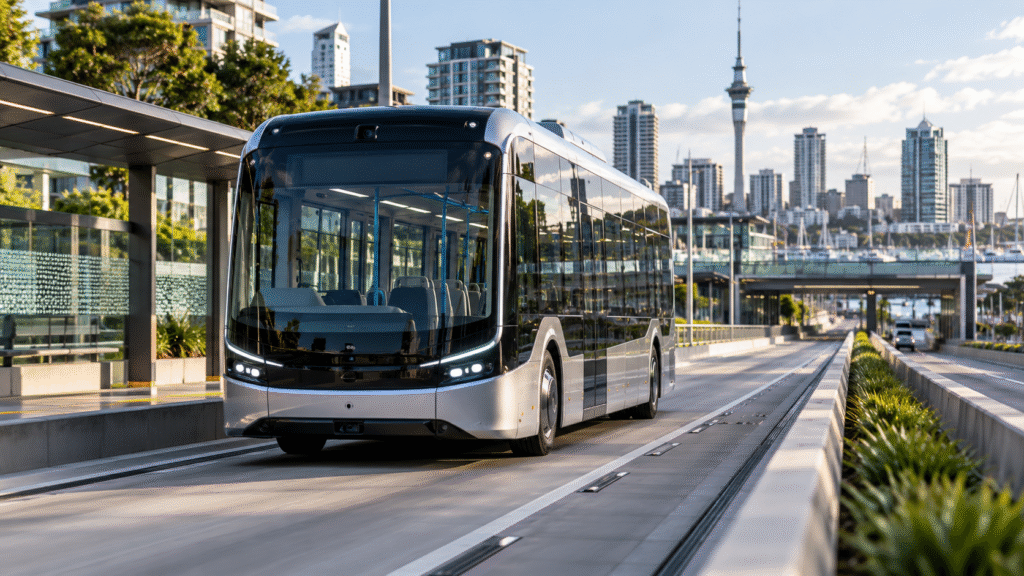
Machines work best where the environment is predictable.
That means the first highly automated public transport services are more likely to work well in places such as:
- dedicated busways,
- airport shuttles,
- closed campuses,
- fixed corridors,
- highly standardised stops,
- separated transport lanes,
- and routes with relatively few unexpected changes.
New Zealand’s Ministry of Transport already distinguishes between partially automated vehicles and higher levels of automation.
At Levels 3 to 5, the automated driving system can perform the full driving task under certain conditions. Level 4 systems may operate without continuous human control, but only within specific environments or operating conditions. Level 5 represents true full automation. 新西兰交通部
The Ministry also notes that New Zealand’s present regulatory framework works reasonably well for Level 2 technologies, but may no longer be suitable if Level 3–5 vehicles begin operating more widely. 新西兰交通部
That matters because an ordinary city bus does not operate inside a laboratory.
It operates inside the real world.
The hardest bus routes are not predictable
Consider what a bus driver may encounter during one ordinary shift:
- a temporary road closure,
- roadworks,
- a narrow residential street,
- parked vehicles reducing road width,
- a badly positioned delivery truck,
- a passenger asking for assistance,
- an unexpected detour,
- a school pickup,
- a wheelchair boarding,
- severe weather,
- an incident ahead,
- temporary traffic management,
- or a location that looks completely different from the digital map.
This becomes even more complicated with:
- school buses,
- charter services,
- tourism,
- event transport,
- rail replacement,
- rural services,
- special operations,
- and temporary routes.
In these situations, driving is only one part of the job.
The human is also interpreting an environment that constantly changes.
The person on the bus may remain — but the role could change
This leads to another possibility.
Instead of replacing the bus driver completely, automation may transform the role.
The future job could become something closer to:
Driver + Safety Officer + Passenger Host
or:
Onboard Safety Operator
The person may still hold the appropriate driving licence and remain capable of taking control of the bus.
But during sections where the vehicle can safely operate automatically, that person could potentially perform other duties.
For example:
- monitoring passengers,
- assisting elderly passengers,
- helping people with mobility needs,
- supporting wheelchair users,
- helping parents or children,
- responding to passenger concerns,
- dealing with antisocial behaviour,
- monitoring vehicle systems,
- communicating with the Control Centre,
- handling emergencies,
- and preparing to intervene if the automated system cannot continue safely.
Then, when the bus reaches a difficult environment:
The human takes over.
The future driver may move around the bus
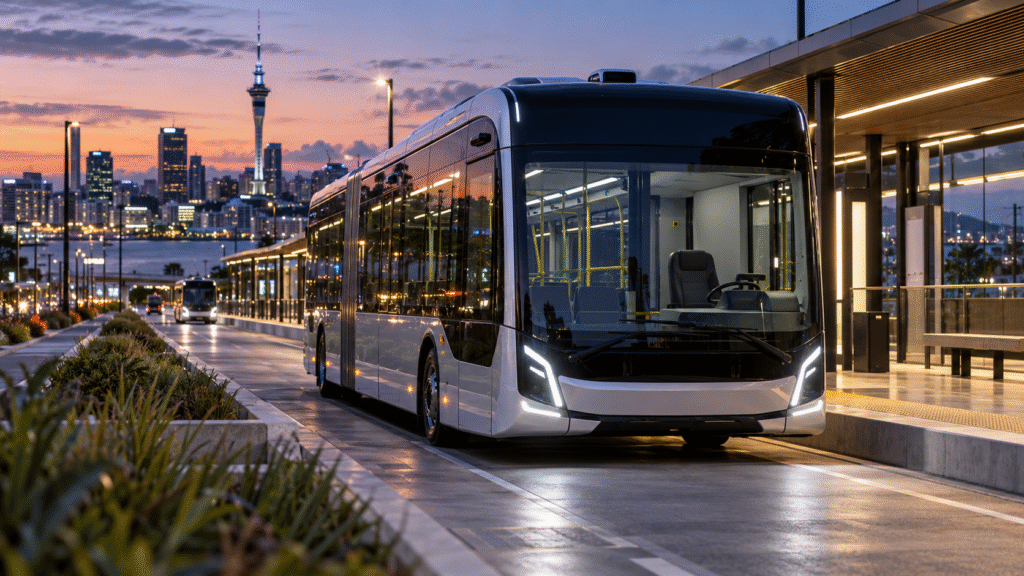
This may be one of the biggest changes.
Today, when a bus is moving, the driver must remain focused on driving.
Even when the driver becomes aware of a passenger who needs assistance, there are limits to what can safely be done while the vehicle is in motion.
The driver cannot simply leave the seat.
But imagine a future bus operating automatically along a well-controlled busway.
The onboard human may no longer need to spend every second controlling the steering wheel.
That could allow the person to move through the bus and help passengers.
They could:
- check on an elderly passenger,
- assist someone using a wheelchair,
- help a confused visitor,
- observe a developing conflict,
- respond to a medical concern,
- support children,
- or simply provide better customer service.
In that world, technology would not necessarily make public transport less human.
It might actually allow the human onboard to spend more time dealing with people.
The future bus driver may spend less time driving — but more time looking after the journey.
A hybrid model may make more sense than full driverless operation
The future does not necessarily have to be:
human driver OR autonomous vehicle.
It could be both.
There may eventually be three broad models.
1. Fully automated operation
This would make the most sense in highly controlled environments.
For example:
- airports,
- campuses,
- separated corridors,
- dedicated busways,
- or tightly controlled shuttle services.
These environments reduce uncertainty and make automation easier.
2. Supervised automated operation
The vehicle performs much of the routine driving.
A trained person remains onboard to supervise the system and manage passengers.
That person may take over when necessary.
This could eventually become suitable for modern urban routes with highly standardised infrastructure.
3. Hybrid human and automated operation
This may be particularly useful for:
- suburban routes,
- school buses,
- tourism,
- charter services,
- temporary services,
- rail replacement,
- difficult terrain,
- and routes where conditions vary significantly.
The automated system handles predictable sections.
The human takes control during difficult sections.
This may be a much more realistic future than expecting every bus to become permanently driverless.
School buses may be among the hardest services to remove humans from
School transport demonstrates why the bus driver’s role is broader than vehicle control.
A school bus may involve:
- student behaviour,
- boarding and alighting safety,
- checking locations,
- communication with schools,
- vulnerable children,
- medical incidents,
- bullying or conflict,
- emergency evacuation,
- and unexpected changes.
Even if technology becomes capable of driving the bus itself, there may still be strong reasons to have a responsible adult onboard.
That person may eventually be called something other than a traditional bus driver.
Perhaps:
School Transport Safety Operator
or:
Passenger Safety Officer
But the human role may remain.
And ideally, that person would still have the skills and licence necessary to take control of the vehicle when required.
Tourism and charter buses are also about more than driving
A tourist passenger does not simply need transportation from Point A to Point B.
They may need:
- information,
- directions,
- luggage assistance,
- timetable changes,
- help with mobility,
- coordination at attractions,
- unexpected route decisions,
- and assistance when plans change.
Charter operations can be even less predictable.
The service being sold is not simply movement.
It is:
someone taking responsibility for the journey.
Automation may reduce the amount of driving that person performs.
It may not remove the need for that person.
Automation today is still not the same as driverless operation
It is also important not to confuse advanced driver assistance with true autonomy.
Tesla, for example, currently describes its system in New Zealand as Full Self-Driving (Supervised).
Tesla explicitly states that these features require active driver supervision, do not make the vehicle autonomous, and do not replace the driver. Tesla
That distinction matters.
A vehicle that can steer, change lanes and negotiate intersections under supervision is very different from a bus that can safely operate every route, in every weather condition, with no human fallback.
New Zealand’s Ministry of Transport also says existing rules may need significant change before fully autonomous vehicles can be widely operated here. 新西兰交通部
So the idea that thousands of bus drivers will suddenly disappear overnight is unrealistic.
But gradual automation is a much more credible possibility.
The real question is not “Will I lose my job tomorrow?”
For bus drivers, the more useful question may be:
What skills will the industry value in ten years?
If automation increasingly performs repetitive driving tasks, the value of being able to simply steer and brake may gradually decrease.
Other skills may become more important.
Future bus workers may need stronger abilities in:
- passenger care,
- conflict management,
- emergency response,
- accessibility support,
- digital systems,
- autonomous-system supervision,
- vehicle diagnostics,
- incident management,
- Control Centre communication,
- manual intervention,
- and basic data and system literacy.
The profession may become broader.
Bus drivers could become more like airline pilots
There is an interesting comparison with aviation.
Modern aircraft are highly automated.
Pilots do not manually fly every second of every flight.
But pilots have not disappeared.
Their role has changed.
They increasingly operate as:
system managers, safety decision-makers and skilled human operators when intervention is required.
The future bus driver could move in a similar direction.
The most valuable driver may no longer be the person who spends the greatest number of hours physically turning the steering wheel.
It may be the person who:
- understands the vehicle,
- understands passengers,
- understands automated systems,
- understands road conditions,
- can recognise when automation is failing,
- and knows exactly when and how to take control.
Automation does not necessarily mean removing the human
This may ultimately be the most important point.
When people hear the phrase “driverless bus”, they often imagine an empty driver’s seat and no staff onboard.
That is one possible model.
It is not the only model.
Another future is possible:
The bus drives itself through predictable parts of the journey.
A trained onboard operator supervises the system and helps passengers.
When the road becomes difficult, the human returns to the driver’s seat and takes control.
Technology handles repetition.
The human handles uncertainty.
And passengers gain more direct support onboard.
That may be particularly valuable on the services where people need human assistance most.
The bus driver may not disappear. The job may evolve.
Electrification is already changing Auckland’s buses.
Automation may eventually change the person working inside them.
But public transport involves much more than steering.
It involves:
people.
safety.
judgement.
service.
unexpected situations.
And those are areas where humans may remain important for a long time.
The future bus driver may drive less.
But that person may become responsible for much more.
So perhaps the real question is not:
Will bus drivers disappear?
The better question is:
What will a bus driver become?
Our view is that one possible answer is already beginning to emerge:
Driver. Safety operator. Passenger host. System supervisor.
Different duties.
Different skills.
But still an important human role.
Electrification changes the bus. Automation may change the driver.
Change does not necessarily mean disappearance.